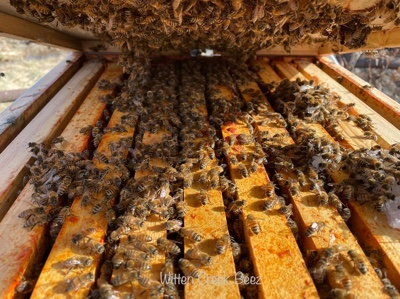
Whew, we have had some cold weather this Winter. Single digits along with a few below zero temps. On each occasional warm day (42-48F) I take a peek under the top cover to check on the clusters and stores. I have replenished the fondant and will again at the next opportunity.
Late on a warm February afternoon
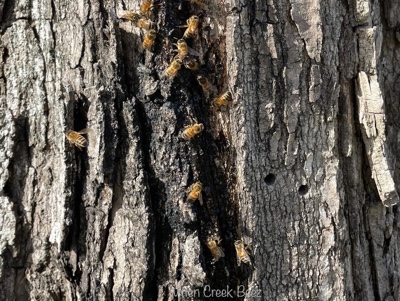
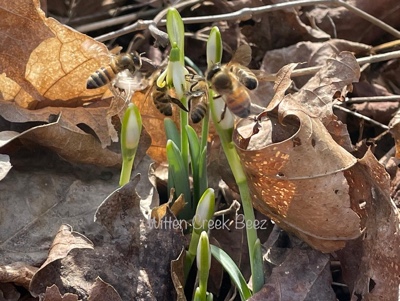
However we are beginning to experience the transition from Winter to the beginnings of Spring. Three days ago it was 63F and the bees took full advantage finding sweet sources from the start of the maple sap run and the ever so small snowdrops.
Maple sap oozing out of a scarTiny snowdrops offering up nectar and pollen
The GDD (Growing Degree Days) climbed to 15 with this warm day earlier in the week but is now 27 reflecting the slow but steady warming.
Here I am now approaching my third year in beekeeping. I’m amazed at what these little creatures have taught me. They helped me rehabilitate from surgery, got me off my duff and moving. They engaged my mind through observation, reading and listening. The amazing people met has been a joy.
In summary of 2021, a swarm from one of my big Spring hives was retrieved. The other two robust hives were split multiple times. The colonies raised new queens and I had to only purchase a couple. A virgin queen I was given was successfully introduced into a hive and accepted, the colonies were treated for varroa mite control and fed to help enable them to get through Winter. It wasn’t a good year for gathering honey but 2022 should be much better.
I have attended beekeeping classes and rubbed elbows with fellow area beekeepers I have met. YouTube has been a helpful resource for learning and being introduced to reputable teachers in the field. Learning to do Oxalic Acid treatments for the control of varroa mites was an experience. I have the smaller wand vaporizer. It has to be hooked up to a battery. Thankfully two batteries were on hand because it takes a lot of ‘juice’ to get the powered oxalic acid to vaporize. After treating 14 hives I can now say I have mastered the technique. ha,ha,ha
OAV treatment End of December
Now I find myself giving back to my community by helping to restart a beekeeping association from the ground up in our county and surrounding area.
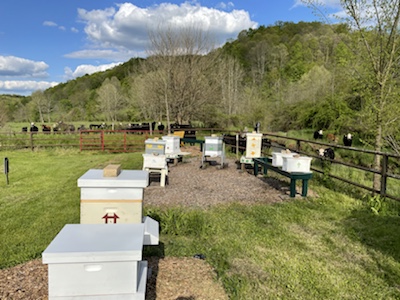
Sights are set on queen grafting to make my apiary more self-sustaining and perhaps produce enough extra to help out local beekeepers who are considering re-queening their hives. A new friend has offered a location to place a couple of hives on. This will allow for more hive management options. Starting nucleus colonies are in the plans as well. Then there is the honey!
If you are willing to develop your dreams and visions and take the action upon them, it truly is amazing what doors open as you take the steps to walk through them. It’s scary at first because you haven’t proved anything. The proof comes in the doing. Sometimes in the form of tripping and tumbling but that just means you are learning. In the end the reward outweighs the stutter steps.
Growth from 3 to 14 hives!
Spring 2022 will take on a whole new meaning! Thanks for following and supporting my adventure.
I haven’t had my bees for a complete year just yet. I still have two weeks to go. So Spring presented a whole new set of experiences. I went from being an enamored newbie beekeeper; happily feeding my bees, treating for mites and doing the Winter prep to a full fledged beekeeper in the speed of light.
The mindset of the bee colony coming out of survival mode in Winter is reproduction. This Spring, the weather became extremely warm at the onset and really flipped the switch to trigger the reproduction cycle which in bees is manifested in swarming.
The residing queen will lay eggs in queen cups. They develop into cells made on the face of the comb or toward the bottom of frames and as they mature resemble a vertical hanging peanut. Therefore upon inspection of a hive this is an observable sign the hive will begin making preparations to swarm. Just prior to the new queen emerging the resident queen will deliberately leave the hive with approximately half of the hive population.
My bees made it through Winter successfully in a robust way. So the combination of a large crowded population of bees in the hive and the warm weather along with an abundance of pollen and nectar provided the optimum conditions for swarming. I was fully aware of these conditions and as a beekeeper began to apply the management portion of beekeeping. This is known as splitting the hive. It is a controlled swarm by the beekeeper.
I successfully split one hive into a deep and a nuc. The other two hives were on schedule to have the same procedure done to them. But the gals had their own time table. I had one hive decide to do a dramatic swarm. I was out talking with the neighbor and I could hear the familiar buzzing sound. I passed it off as flies sunning themselves on the side of one of the outbuildings. When the conversation ended I headed toward the apiary and that’s when I went into frantic mode. I was literally standing in the midst of a full on swarm. Thousands of bees were swirling around the entire apiary. Thankfully they landed on an old fence post ten feet from the bee yard on the apiary side of the creek. I had already placed empty woodenware in the yard. I was pretty hyped as I had never retrieved a swarm before. But my desire to get my bees back took over and my focus kicked in. I successfully got the bees in a single deep hive and transported them away from the bee yard. Whew!
Spring is an exciting season as all of God’s creation awakens with life once again. Regeneration and bountiful hope of an abundant harvest. These amazing bees have taught me so much allowing me thankfully to become a better beekeeper.
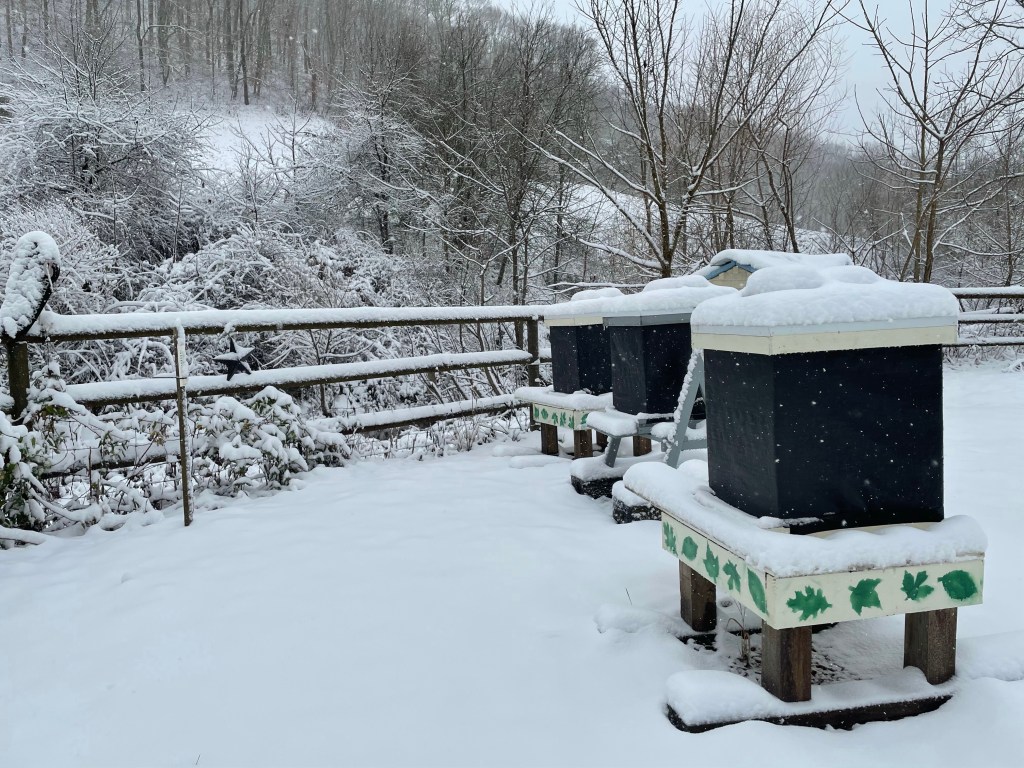
This is what I prepared the hives for. It is so different going into the Winter months with bees. The song by the BeeGees (lol) – “Staying Alive” comes to mind. Thankfully the Winters here are not extreme. This snow accumulation of three inches has lasted for around week but is all gone now. Just enough snow to let us know Winter is coming.
Each morning I make my way to the bee yard. I inspect the entrances and look around the hives. Then I stop to listen. Even with the snow flying and the temperatures dropping I can hear the amazing hum of the bees in the hive. It is a peaceful and almost comforting sound to me. I know they are alive and well and that puts a smile on my face. On the surface it would appear nothing is going on until you can hear them. I have discovered I can hear the bees better if I go to the front of the hive near the top entrance/ventilation notch. This way I don’t make any noise on the walls of the hive. I also read somewhere that making noises such as knocking on the sides of the hive causes the bees to consume more honey. In the Winter the more honey they can conserve the better.
I was amazed when I learned honeybees do not hibernate and stay active all year long. This why when the temperatures get over 40 you will see bees flying about. Cleansing flights are performed and some even come back with some pollen.
During Winter the bees cluster and stay warm. They go into a state of torpor when the temperature gets cold. Torpor is like intermittent ‘hibernation’ or a low energy state to conserve their consumption resources.
Tomorrow the forecast is for a high of 54 degrees and then the temperature will dip down to 19 degrees on Christmas Day! Crazy, eh. I will be on the look out tomorrow for the busy little gals taking cleansing flights and cleaning up the entrances.
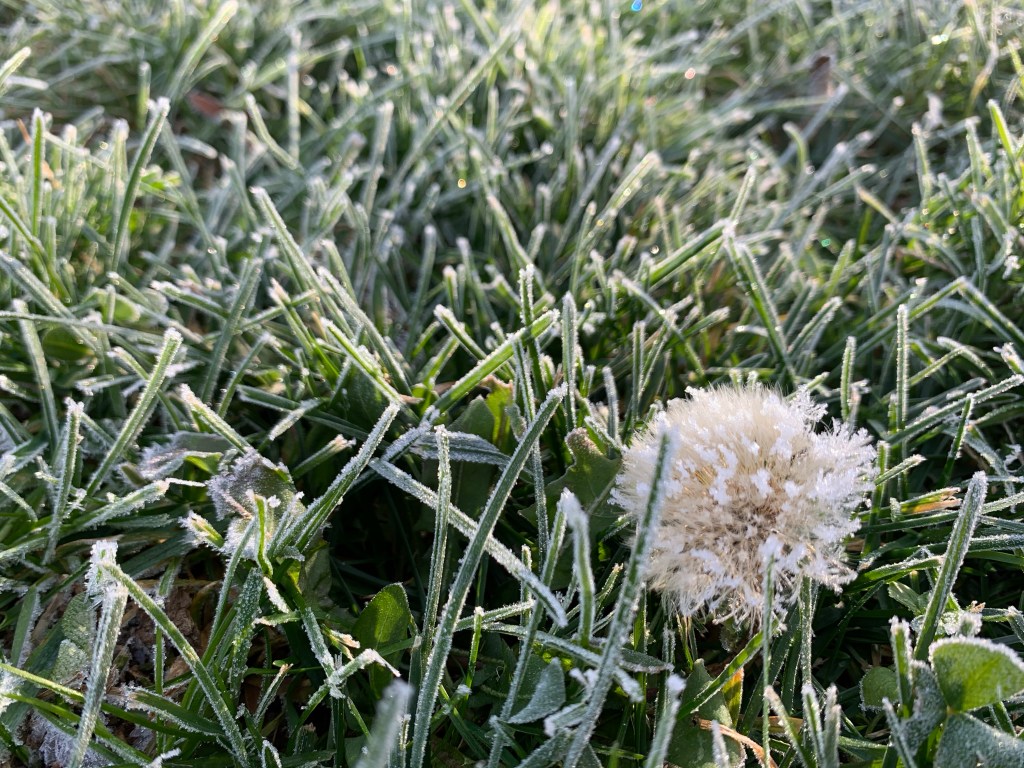
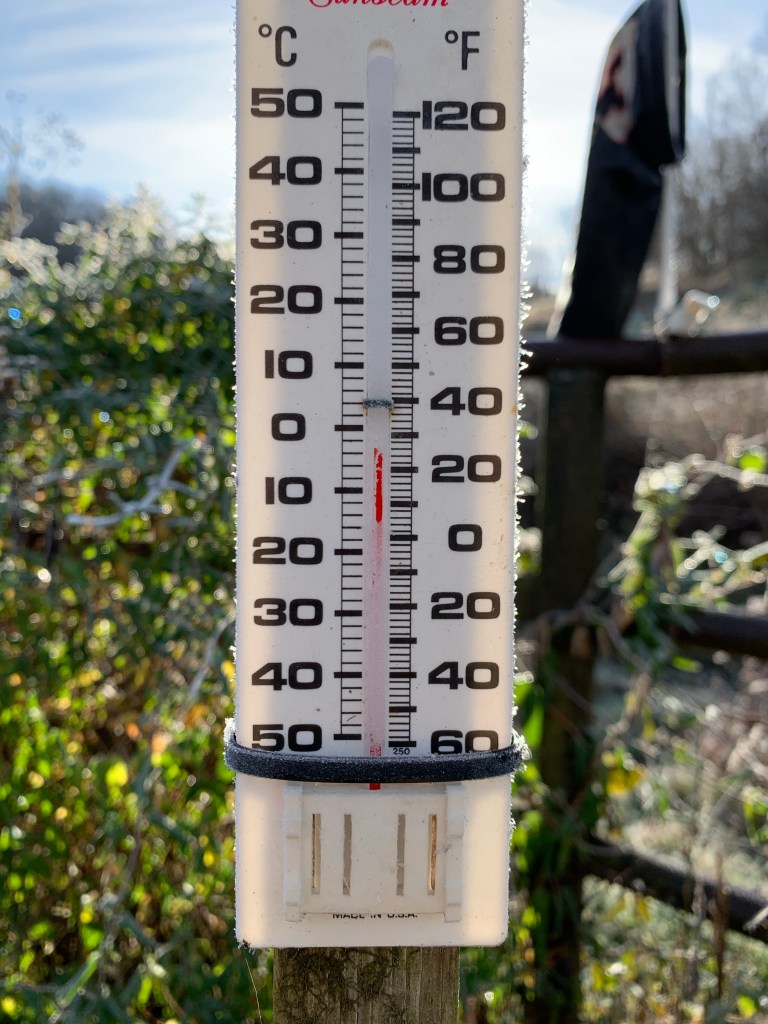
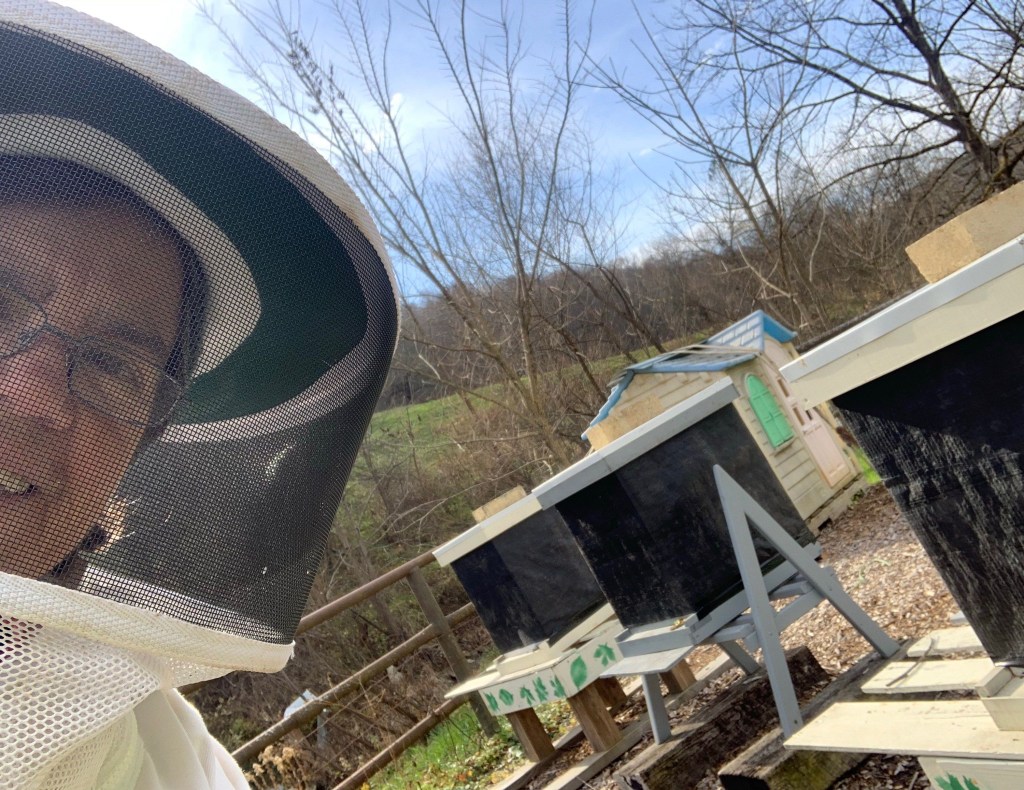
Its a beautiful sunny morning here. The bright sunshine is deceiving. It is still below 32 degrees Fahrenheit at 9:00 AM. After my coffee in the morning, as is my habit, I take a stroll to the bee yard and check the entrances and walk around the hives. I put an ear to each one to listen to the steady hum of the hive. Since I have screen bottoms, I pull out the “gator board” – corrugated plastic cardboard- to look for any moisture. The cold isn’t as much of an enemy to the bees as is cold dripping moisture. The bees naturally cluster together to stay warm. This warmth gently transfers to the surrounding air which rises and contacts the surface of the colder inner cover. If the inner cover is cold enough the warm air will condense back into water, collecting on the surface and then dripping down on the cluster. This scénario is a death sentence to the hive. Thus the reason to place insulation board on top of the inner cover after flipping the inner cover over to allow the notch to serve as a ventilation pathway and provide another bee entrance. I wasn’t satisfied with the 1/2” insulation so I added another insulation boards to provide an inch of insulation. It looks like it is doing the job. The hives were placed in a southeasterly direction for the purpose of maximum sunlight and lessened winds. The black rhino wrap is doing a fine job as well. The front and partial sides were nice and warm to the touch.
The time has come to wrap the hives in preparation of Winter. I cracked open the outer cover to see how the bees were managing. All looks well. I placed the bee fondant on the top of the frames and then snugged the bees back up. I’ll check again within the next couple of weeks when we have another warm sunny day before the real cold hits. I am curious to see if the bees devour the fondant and make an accessment of the new wrapping material.
The back story:
I was informed there was ‘tar paper’ or roofing felt in the machine shed I could use to wrap my bee hives with. Turned out what I found instead was ‘Rhino roof underlayment’. It’s a synthetic thin yet strong liner. It is waterproof and should block the Winter wind along with with absorbing the warmth from the sun. It was very easy to handle and secure to the hives. I just took some measurements, cut the liner with scissors and a draw knife. Then headed out to the bee yard after grabbing some black 1.5” wide inch vinyl tape and staple gun with 5/16” staples.
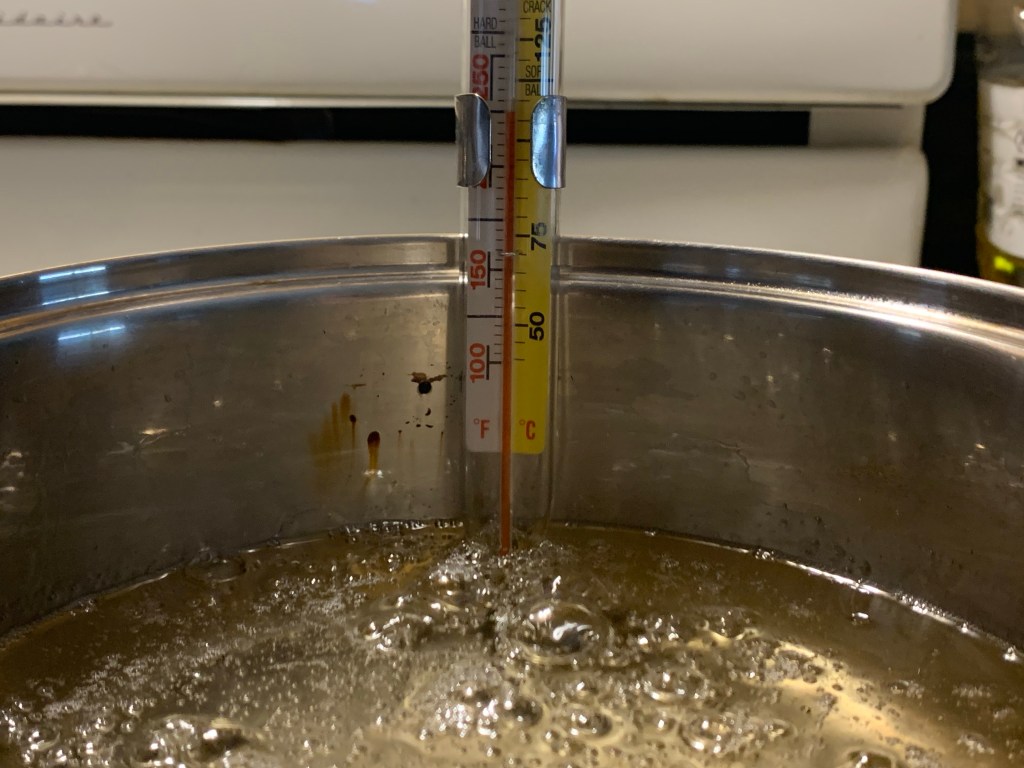
With a break in the weather and lots of sunshine I decided to make some bee fondant or icing. Thankfully I have made hard tack candy before during the holidays and know it takes some patience to reach the appropriate temperature. In this case the sugar concoction has to stay below 234 degrees. That’s a good thing because it takes a long time to evaporate enough water to achieve the temperature. Temperatures over 234 degrees will alter the sugar in a negative way for the bees.
Temperature slowly climbing
After 234 degrees you remove from heat and let it cool down to 200 degrees. Then get ready to spend at least 10 minutes whisking the mixture until it turns white and starts getting slushy for lack of a better word. Then you finally pour it out on to wax paper with a dish towel underneath it.
These patties of fondant or icing can be stored in a ziplock bag in the refrigerator. I’m holding off placing these in the hives until the weather consistently stays cold. When that time comes I won’t be opening up the hive again until the next occasional warm day. Then I can report back on how well these worked.
Well things happen! All the while the focus has been on the bees I didn’t consider the repurposed playhouse (which is now a small tool shed) getting blown away. Yesterday it was windy all day and into the evening. There were lots of limbs and branches down. It was a bit unusual to have so much wind.
Oops!
The tool shed which houses my smoker, toolbox, bucket of hay and robber screens is a repurposed Little Tikes playhouse. The playhouse has been a brooder house for red golden pheasants, an infirmary for a recuperating chicken on occasion , and a garden shed. It even survived an electrical short from a brooder lamp to keep peeps warm. It just keeps on giving. Now it is safe and secure.
Ratchet strapped down to stake and iron fence
It was a chilly 30F this morning. The bees weren’t out so it made the repair work much easier without them buzzing around specially since my helper gets nervous around the bees.
The forecast for the week is showing a warming trend. It will be a welcomed break for the bees and us before it starts staying cold.
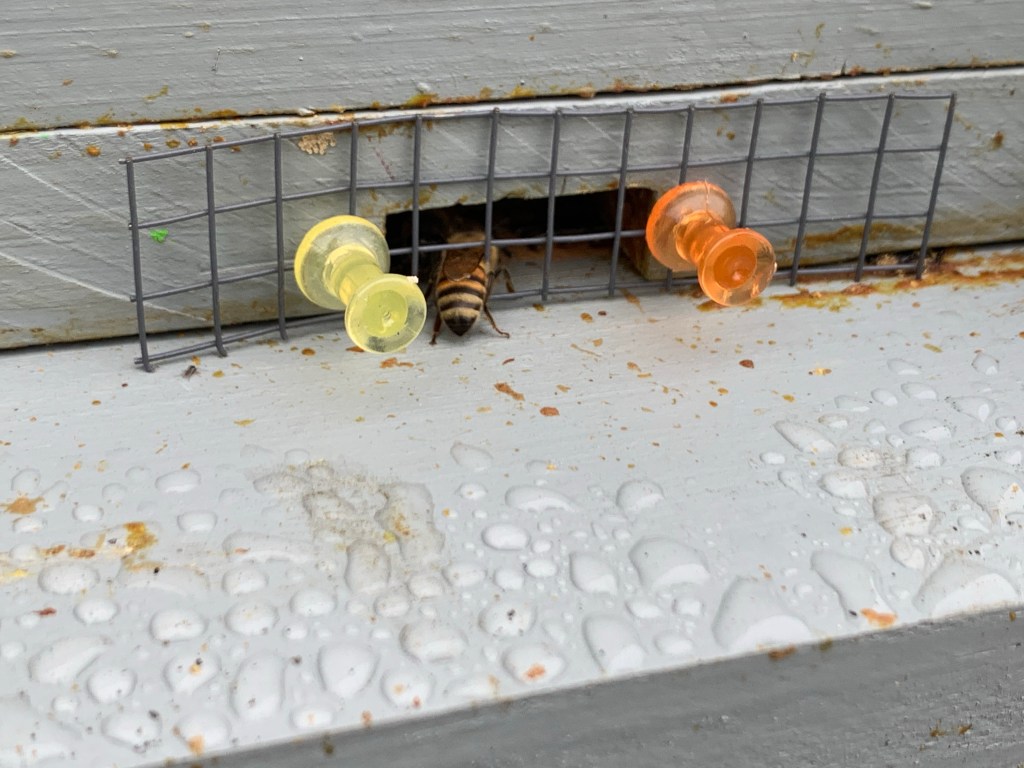
This week the weather has turned more seasonal. Rain drizzle, Autumn leaves falling and cooler evening temperatures signals to me; mouse guards. As the temperatures cool off the bees cluster within the hive to keep themselves warm and at a constant temperature. The cozy bees hardly ever break from this group togetherness allowing a freezing mouse to waltz on in through the hive entrance. To a mouse this is like hitting the jackpot. To the bees the invasion spells disaster.
The mouse guard is a rather low tech device. Requires no wifi, or broadband. Just a wire cutter, some screen mesh to allow the bees to come and go but no entrée for a mouse. You can easily spent 15 bucks on a thin metal strip with some holes drilled into it. Or you can use wire mesh like I did. But believe it or not in this high tech world and the internet I couldn’t find a definitive answer in the mesh size. I ended up purchasing 1/4” mesh only to discover the bees were apprehensive about going through. A few did but I wasn’t satisfied. Several sources indicated a mouse could get through a 1/2” opening but the 1/4” seemed small. So I have determined 3/8” openings on the mesh are best. Ha, ha. I took a screwdriver and made the opening slightly bigger and voilà the bees acted like nothing was there. No sharp edges for wings or toes to get caught on.
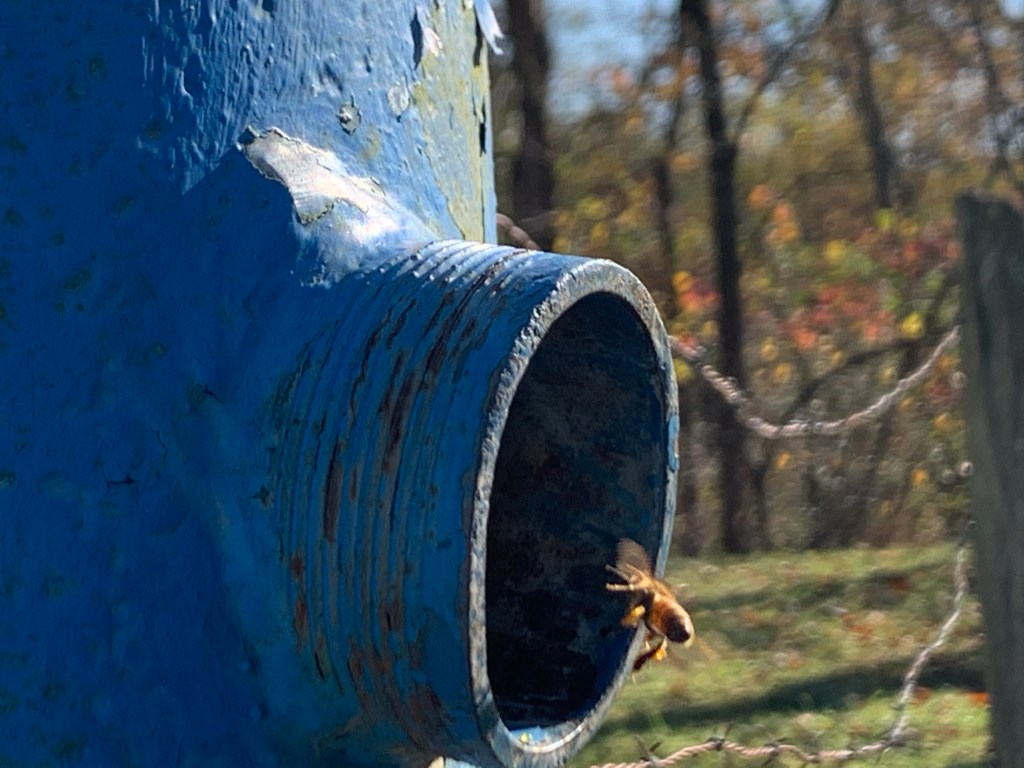
Got a lead from the mail delivery person there was a gent who was wanting to get rid of some honeybees. They had taken up residence in a gate post made out of 8” well casing pipe. I explained to the landowner the best thing to do was wait until Spring and trap them out using the ‘No bee left behind’ method. I could smell honey emanating from the large entrance. Letting the landowner know the best thing for the bees to survive was to let them stay and feed off of what they have and are storing up for the Winter, allowed him enough information to understand leaving them was the best thing. He is aware of the benefit of honeybees to everyone’s survival. He didn’t want them exterminated and appreciated the informal bee education.






 Witten Creek Beez